It's beginning to look a lot like Christmas! Get excited! Okay, I realize we haven't even celebrated Thanksgiving yet; but seeing as Christmas decorations have been in stores since July, this message could actually be considered a bit tardy. Alright, on to the topic at hand...
When running for political office, it seems that women are often encouraged to "put on masculinity." This could be for a variety of reasons, but it's most likely primarily due to the fact that many people, women included, still feel that females are not suited to command positions of political authority; they believe women are too sentimental to hold office, cannot make political decisions independent of issues in their personal lives, whatever the case may be. For example, during the 2008 Presidential Campaign, Hillary Clinton chose to wear pant suits when she traveled around politiking, resulting in a more masculine image. Ironically, she was criticized for doing so after she was defeated in the primary election; some political theorists say she might have been able to gain more votes--particularly female votes--had she chosen to emphasize her femininity and her political qualifications simultaneously throughout her campaign. However, on the other hand, Sarah Palin chose to appropriate her femininity when constructing her vice-presidential campaign, not only by wearing suit skirts and designer clothes, but highlighting her role as a mother with a family as well. (Interestingly enough, both of these women failed to obtain their desired political positions. What's a girl to do? N.B. I'm trying to keep this blog entry at least somewhat politically neutral.)
On the flip side, men are sometimes encouraged to take on more "female" characteristics in their relationships with women. I realize I'm overgeneralizing here, but many women tend to like men that are sentimental and in touch with their feelings; however, men traditionally are not the "sentimental sex." Ironically, for men to satisfy their "masculine" urges, they often need to appeal to their emotional, "feminine" side in an attempt to please women. My, what a tangled web we weave indeed!
Greetings! Below I have posted for the benefit of all: "A Tale of Truth!" Or is it all that truthful? I'll leave that to your judgement... ;)
Charlotte's parents seem to possess considerably respectable personalities. Charlotte's mother, Lucy Eldridge, is "everything that is amiable and lovely," and Mr. Temple, though exceptionally benevolent, is "warm," "impetuous," and "unacquainted with the world." "His heart had not been rendered callous by being convinced of [the world's] fraud and hypocrisy." Her parents are reminiscent of those in many of the magazine articles we've read: practically perfect in every way, an 18th century Cleaver couple... or are they? It seems characteristics of each could have, at least indirectly, contributed to Charlotte's "fall." After all, her innocence of mind and impulsive decisions cause her to end up in disastrous circumstances--personality traits that one or both of her parents are said to have! Apparently, the old saying "the apple doesn't fall far from the tree" has some validity.
While Charlotte's parents are a good-natured, good-intentioned couple, certain ways in which they chose to raise their daughter also seem to have played a role in her demise. Charlotte, for the most part, is too trusting of people, as seen with her decision to continually meet Montraville, a man with whom she is only mildly acquainted, under "shady" circumstances. Though she seems to know deep down that she's making the wrong choice, the naive part of her personality never fails to overshadow her apprehensive intuitions. Perhaps if her parents had taught her to be more cautious and suspicious of strangers, she would not have ended up in the predicament she did. (Though this might have proved difficult for her parents, since they seem to possess a pretty rose-colored view of the world themselves.)
Taking Charlotte Temple's tale into consideration, it seems some parents should be a bit more liberal with respect to how they choose to educate their children. For example, some couples raise their sons and daughters with a limited knowledge of sex, leaving their kids to "fend for themselves" and obtain knowledge of this nature on their own. However, if kids are brought up with a more extensive understanding of appropriate/safe sexual conduct, etc., they can make intelligent, informed decisions that will likely lead to better outcomes than those that came of Charlotte's choices. After all, knowledge is power!
"I put a spell on you: And now you're mine!" No, not really... don't be scared... just felt it would be appropriate to open with a Hocus Pocus quote since Halloween is tomorrow. Anyway, down to business:
As far as modern causes of female depravity are concerned, I think women's obsession with fashion could be seen as an indirect cause of sexual promiscuity. (This is a little bit of a stretch, but humor me for a moment.) Though an interest in fashion and one's physical appearance are certainly acceptable (and somewhat encouraged--Does anyone remember the 80s? I try not to... definitely want to try and avoid a complete fall-back into ways of dressing that resemble those of a blind pre-schooler), a passionate desire to consistently sport the latest trends could lead to licentious behavior. Contemporary female fashion (or at least contemporary TCU fashion) often involves wearing extremely skimpy, form-fitting clothing that leaves nothing to the imagination. Also, in contrast to typical 18th and 19th century female fashion, 21st century clothing that covers little and allows for more mobility makes a woman more sexually accessible. Though a woman's decision to wear the latest raunchy piece of apparel could be an attempt to engage members of the opposite sex, her choice to do so may not be primarily sexually motivated... perhaps a wish to be "trendy". Taking this into consideration, when a man "looking for some action" (maybe one of our modern day rakes) sees a scantily clad woman, he could assume based on what she' wearing (or in this case not wearing) that she's "easy" and choose to pursue her, opening up said woman to sexual temptation. Though the decision to dress in a promiscuous manner doesn't necessarily directly result in sexually liberal acts, it can certainly be seen as an inciting factor. (Note: I would have provided a picture of the sort of 21st century woman I've just described, but I didn't want to have to go back and check off the "this site contains pornographic material" box on my blog settings.)
An obsession with fashion can also lead to physical and mental depravity--not just sexual. In addition to "showing off the goods," contemporary clothing trends often require/encourage a woman to be exceptionally slender, hence the increasing prevalence of anorexia. Also, a strong interest in one's physical appearance encourages excessive materialism (the never-ending desire for the latest clothing, beauty products, etc.), resulting in a decrease in attention to matters of an intellectually stimulating nature.
Hmm... it seems to me, concerning the texts discussed over the last three weeks, my salutation says it all--women were encouraged to maintain their chastity at all costs. I realize that this is fairly obvious and that this notion has already been analyzed at great length in class, but perhaps there is still a bit more to be said.
It's interesting that men (since we have deduced that it is likely that the majority of texts discussed in class were male-authored) chose to re-enforce virtuous behavior for women, particularly with respect to their sexual conduct. This seems rather counter-intuitive, since it would appear to be to a man's benefit for a woman to be "loose"--this would make it easier for him to appease his "extensive" sexual appetite (a characteristic that is supposedly typical of a male). Even though "double standards" in place are much more lenient for men with respect to sexual activity, it is difficult to indulge and take advantage of loosely defined boundaries when women are strongly encouraged to behave in the other extreme: to avoid sexual promiscuity.
On another yet similar note, 18th century and 19th century female fashion further promoted the preservation of chastity. Copious undergarments, corsets, and extremely intricate button sequences on dresses made the act of removing clothing difficult (not to mention moving in general), thereby discouraging immoral, licentious behavior.
Although women often wore corsets to achieve a particular body shape and excessive buttons on clothing were part of the extravagant nature of Victorian style, they certainly aided in encouraging women to protect their virtue. Similar to Chinese foot-binding (though significantly more painful than corsets), restrictive clothing was a way of forcing women into physical submission by limiting their mobility, which re-enforced patriarchy as a result.
Greetings... I hope none of you have fallen prey to rakes since we last spoke. Then you would have to drink poison to escape from your guilt... (for a detailed account of the effects of drinking poison, please see Socrates).
So, what exactly does love have to do with the seduction texts we've read? For one, choosing to put love in the narratives helps make them, well... narratives. In many of these texts, love serves as a plot developer, which allows the seduction "accounts" to take on a stronger story-like quality. Additionally, rather than simply describing typical characteristics of rakes so women can recognize and avoid such men, adding in romantic details potentially makes the narratives more engaging--especially for women (at least in theory). Because women were characterized (and still are characterized) as the "sentimental" sex, adding in sentimental details could have been an attempt by the men (presumably) who wrote the narratives to appeal to the interests of women in order to encourage them to read their advice.
On the other hand, in the seduction narratives we have read, women are victimized by their love-- emotional vulnerability is often what eventually causes a woman to loose her virginity. Therefore, these texts seem to inadvertently discourage being overly sentimental. In a sense, these narratives are an extension of the behavioral advice texts we read earlier in the semester; they are still a means of attempting to regulate female behavior and in order to promote submissiveness and to encourage women to maintain their "most important asset": their virginity.
I don't think a dependence on love was seen as a rejection of the patriarchal structure. I understand that such a dependence could potentially undermine the authority men had in arranging marriages, but it's not just women that seek romance in a relationship: men fall in love too.
Good day to all. I hope you are enjoying your break of an autumnish nature. Before I embark upon another blogging escapade, I would like to call attention to the recent renovations my blog has undergone: I've added PICTURES to many of my entries! Please peruse through my blog and feast your eyes upon newly-added, utterly delightful rectangles of pixelated pleasure... whatever the heck that means.
For those of you that know me, I doubt you'll find it surprising that, when asked to describe an example of a contemporary rake, the "fashionable or stylish [men] of dissolute or promiscuous habits" (Special thanks to the OED for this superb definition of a rake) that first came to mind were those from previous centuries. (Oh, the woes of those whose minds dwell on days of yore...) Though I was able to come up with an example of a modern-day rake, I thought it a shame to not mention the other "antiquated" examples I had come up with. Thus, I've decided to dedicate this blog entry to briefly analyzing the progression of the image of the rake since the 18th century.
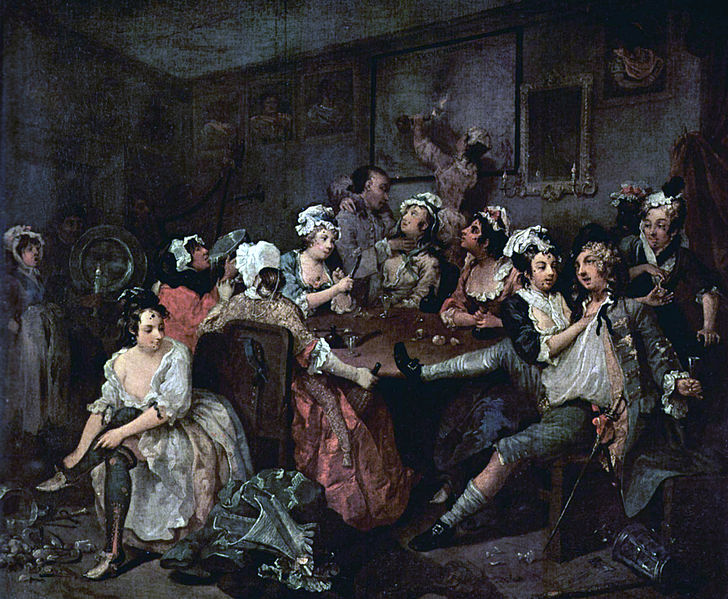
I feel it's only fair for me to begin with a discussion of one of William Hogarth's series of paintings, The Rake's Progress, seeing as this work was the inspiration for my blog title. For those of you that are unfamiliar with Hogarth, he was an 18th century English painter, who, among other things, was well-known for satiric depiction of the aristocracy. In The Rake's Progress, Hogarth tells the story of a man who inherits his father's fortune and uses it to fund a superfluous and ostentatious lifestyle, which, of course, included habits of a promiscuous nature. The rake's reckless ways eventually cause him to end up in Bedlam, a mental institution in London. The image I've provide below is the third painting in the series, "The Orgy." Eh-hem... I'm assuming there's no explanation needed here...
Moving right along... George Gordon Byron, a.k.a. Lord Byron, also seems to fit the OED's definition of a rake. Byron was an English Romantic poet, whose "reputation" extend beyond things of a literary nature (One of his most famous poems is "She Walks in Beauty, which you can read here: http://www.bartleby.com/101/600.html.). Because of his poetic prowess and handsome appearance, he was often an object of sexual desire for many women of his day--the 19th century Clive Owen, if you will. With a vast array of women at his beckon call, it's no wonder he led such a lewd lifestyle. (However, considering Byron's notoriously pleasure-seeking personality, it's likely that he would have found other ways to appease his sexual appetite had there been a lack of willing women.) Below is a picture of Lord Byron... quite the Don Juan if you ask me. (Ironically enough, the term "Don Juan," among other things, refers to a semi-autobiographical poem written by Byron, which tells the story of a sexually promiscuous male.)
The next rake on my list is also from the 19th century. However, unlike the above rakes, he is a fictional character from the 1939 film, Gone With The Wind, adapted from the novel by Margaret Mitchell. His name is Rhett Butler. For those of you that haven't seen this movie (By the way... you SHOULD! It's EXCELLENT! Definitely one of my favorites.), Rhett is exceptionally wealthy, but has "the most terrible reputation," to quote a gossiping woman from the film. Although throughout the course of the movie, Rhett is wooing (or at least attempting to woo) one woman, the heroine, Scarlett, he frequents the local house of ill-repute where his good "friend" Belle Watling is the "madam." Here's a funny video clip from YouTube that contains many of the scenes from the film in which Rhett exhibits sexually promiscuous behavior. The song "Tough Lover" is playing in the background: how appropriate.
At long last, we arrive at the present day: The contemporary rake is... drum roll please... Joey from the film 10 Things I Hate About You. Joey, like our other rakes, is wealthy, takes pride in his appearance, and, of course, harbors a wanton lust for a fleshy love; he's a horny high-school boy, who, to use a colloquialism, "gets around." Like some of the rakes from the readings, Joey takes pride in "conquering the virtuous." His object of desire, Bianca Stratford, is not only one of the most beautiful, popular girls in school, but a virgin. Here's the movie trailer, in which Joey makes a brief cameo with Bianca at the tail end of the clip.
The character of the rake doesn't seem to have changed much over the course of the 18th, 19th, and 20th/21st centuries. All harbor similar personality traits, and certainly fit the description of the seducers Early-American advice texts urged women to be on the watch for. Though they may appear mannerly and suave, their ultimate goal is to fornicate with females.
Greetings fellow coquettes *cough*witches*cough* (Yeah... still missing Salem...),
First of all, I'd like to send a shout out to all of the pure-hearted, good-intentioned men that spent time creating texts especially for me in hope of furthering my "feminine" education and influencing my development as woman (but of course, not as an individual, since I should not seek to cultivate a sense of personal identity, but blindly submit to blending in to a patriarchal imposed description of female norms). Your concern and interest concerning the education of women is truly touching, and I'm sure the best and brightest of my sex consider your advice to be invaluable: priceless...
PriceLESS, because a monetary value can't be determined, seeing as there is no going rate for absolute crap on the market.
Anyway...
When I read these "instructional" texts, primarily, I see the age-old tendency to encourage women to remain sexually pure, and embody the essence of all that is delicate and matronly. A woman must maintain her Virtue or face losing not only her reputation, but also her decreased value with respect to, or in some cases, complete removal from the marriage market. To paraphrase:
A woman should be the physical manifestation of all that is good, a marble idol of chastity and pristine morality that should never waver, falter, or tarnish. She is merely a decorative article that exists only for the purpose of pleasing her husband, one that sits on the kitchen mantle quietly and waits with wide eyes and unwavering devotion in hopes that he might bless her with a passing glance. Whenever he feels the desire, he will wrench her from her resting place, and with a fist constricted tightly around her torso, brush the dust off of her body with an air of bombastic ambivalence, and return her to the mantle with a fierce SLAM.
Well, this may be a slightly hyperbolic paraphrase (and I may have brought in a few things that weren't specifically mentioned in the advice passages), but the purpose behind the construction these instructional texts for women seems to be the same one behind the 1950s home-economics textbooks: an effort by men to maintain the prevailing patriarchal order via the encouragement of feminine weakness and submissiveness.
Also, as I read these texts, I started to wonder why men felt the need to publish them so extensively--why specifically during the late eighteenth century did they feel their authority was in jeopardy? Since a handful of these texts were published during the "Critical Period" of American History, I wonder if it was a response to Republican Motherhood of sorts, an attempt to reclaim some of the agency women had gained with the success of the American Revolution. Anway, it's just a thought.
It's been a long night dancing in the woods with Satan, venturing out with lewd men, killing children, pillaging... well... you get the idea... Anyway, after all of my adventures (or rather misadventures), I feel like I'm equipped to answer the question at hand.
I've enjoyed reading these narratives; I've never picked up anything quite like them before. It's been interesting to watch them change and develop as the years in which they were published progress--a change that is reflective of the social and cultural developments between the late seventeenth century and the early nineteenth century. Overall, I have two primary observations to make about these texts:
1) As the narratives move from the Puritan "come-to-Jesus" tale to an adventure story of sorts, such as the "Panther Narrative," sexist comments and attitudes toward women seem to become more subtle. While one would like to think that this is evidence of American society moving away from patriarchy to a more egalitarian community, which would result in enlightened/better informed ideas about women and feminine nature, this is unfortunately not the case. As discussed in class, though women in Puritan New England were generally intellectual inferior to men with respect to their lack of a formal education, they still could read at a standard level and possessed the basic academic competencies needed to function in everyday life. However, as the years progressed, women gradually became more educated. There seems to be an inverse relationship forming between the amount of overt sexism present in the narratives and the extent of the scholarly and academic capabilities of women: as the latter increases, the former decreases. Obviously, if women are becoming more intelligent, therefore more able to recognize male diatribes against females, such commentary is going to need to be subdued. Though this may seem good, more subtle attacks against women are actually potentially more dangerous because they're harder to recognize--readers of narratives can be negatively influenced without realizing it!
2) On a more general note, the more recent narratives seem to be geared more toward entertaining the masses rather than moralizing/serving as a model of "good behavior." Although there are certainly morals, thoughts, and ideas that are promoted in newer stories (ex. "The Panther Narrative), they are nowhere near as blatantly emphasized as they are in earlier tales of religious revelation (ex. Esther Rodgers). Perhaps this is indicative of a gradual move toward secularism and a more consumer, entertainment-based culture.
Good morrow to all of you wacky witches! ( I know we're done with Salem, but I'm still in mourning... at least allow me to cope with weak attempts at being humorous.)
It's kind of ironic... we've been reading these infanticide narratives with the understanding that multiple parts of a so-called "true account" were likely embellished, but I feel like certain parts of the narratives give a relatively accurate representation of some of the females at TCU. Now, as of this moment I haven't met a girl who's guilty of infanticide, but I have certainly overheard many a tale of extreme sexual promiscuity. I don't consider myself a prude, but based on what I've gathered, TCU seems to be an incubus of venereal diseases. (It's like the royal court of Henry VIII... well... sort of...)
Though I don't approve of women who sleep with everything and all things male, I don't feel like women should be judged for this sort of behavior... especially if men exhibit exactly the same behavior and no one gives it a second thought--the ol' double-standard. I think people can at least agree that for health reasons that being sexual loose isn't a good thing... but for crap's sake, it's not just women who spread STDs!
On another yet similar note, though women have the option of pregnancy termination and a variety of contraceptive devices at their disposal, I feel like they're often judged for their choice to utilize these resources. This isn't necessarily true in all cases, but regularly enough to note. For example, I think people tend to automatically assume that if a woman chooses to abort a baby it's because she made sexually careless choices, which may not actually be the case (What about rape, health reasons, financial issues, etc.???). Though woman have certainly come a long way in the last hundred years, it seems to me that age-old prejudices and stereotypes are still prevalent.
So... I've been trying to think of something really interesting and thought-provoking to say for this blog post... unfortunately, the muses have not been kind. I ask forgiveness for the mediocre quality of this response in advance.
I did enjoy reading the Rountree article. The concept of goddess vs. witch reminded me a lot of the Victorian (or at least the average Victorian male) conception of women: A woman was either a virtuous Victorian virgin or a "Fallen woman," (a phrase often used to refer to a prostitute) a social "castaway," if you will, to reference Augusta Webster's dramatic monologue told from the point of view of a "lady of the evening." (If you are interested in reading this poem, you can find it here: http://rpo.library.utoronto.ca/poem/2563.html) I realize I'm over-generalizing here, but for the most part if a woman failed to or did not aspire to become a domestic maternal Madonna of sorts, society gave her the stink eye (Note: Society=patriarchy. *cough*menaredumb*cough* Ha-ha. Just kidding... sort of...). Assumptions and judgements were often made about a woman based on her profession alone, that of course weren't necessarily true. For example, many single women became seamstresses in order to make ends meet. However, this job paid so little that it wasn't uncommon for seamstresses to take up prostitution in order to feed themselves. For this reason, being a seamstress was often equated with being a prostitute.
The role of the color pink in the feminist movement strikes me as a good example of "reclaiming agency." Pink is often rejected by feminists because of its sentimental, delicate, and "girly" connotations; to some it represents cliche female gender norms. However, lately the color pink has been embraced by feminists who see it as a color/symbol that can "speak" for women as a whole, not just "girly-girls." I don't know if this made any sense... I read an article on it once, which of course now I can't find... rats. I guess you'll just have to take my word for it. I swear on A Tale of Two Cities that I'm telling the truth! :)
Good day witches of Salem. I have for ye a tale of horror and woe...
No, not really. But I do have a few stories concerning my accounts with the supernatural. Allow me to share one of them with you. (Ask me if you would like to hear more... I'd love to share!)
When I was in Salem, my cousin and I thought it would be fun to run around some of the old graveyards at night (By the way, I wouldn't recommend this unless you're with someone; there are SO many creepsters that hang out in cemeteries at night). It just so happens that the graveyard we decided to visit that night was the field where Giles Corey was pressed. While we were exploring, I felt like someone was behind me. I turned around expecting to see my cousin trying to scare me, but instead saw an orb. (F.Y.I. An orb is a white glowing sphere that is supposedly what appears before a spirit manifests itself.) I stared at it for about three seconds, and then it slowly faded away into the darkness. Much to my chagrin, I was not fortunate enough to see the ghost of Giles Corey, who is said to appear in that field now and then. (However, seeing his ghost is suppose to be a bad omen. The last time it was spotted was in the late 1990s by a ghost tour group. The next day a boy from the local high school killed himself.)
When I think of modern "witch hunt", the first thing that comes to mind is the McCarthy communist raids. Kudos to Arthur Miller for making that connection and putting his thoughts into the form of an utterly delightful play. Mmm... John Proctor...
I've actually had the misfortune of experiencing something similar to a witch hunt. When I was in high school, one of my teachers got wind that someone was selling typed sets of the lecture notes. Everyone was brought to her office and forced to show her their notes so she could review the them to see 1) if they were typed, and 2) if they matched the ones being sold. If the slightest phrase or sentence was even remotely similar to the contraband copy, she became suspicious. Lucky for me, I hand wrote my notes, but my friend typed hers. She was subsequently accused of cheating (erroneously I might add) and a portion of her semester grade was deducted as a result. I told my friend, who is of outstanding moral fiber, that she was the Rebecca Nurse of her time. She told me to shut and and quit being such a history nerd.
As far as a contemporary concept of evil is concerned, I think people often associate "evil" with what doesn't fit or match their concept of what something is... like any sort of modern day religious fanatic, for example. Like the Puritans, they see things in binaries; there's no room for error--no middle ground--only good and bad, right and wrong, saint (Elect) or witch.
My name is Emily Cody, and I'm senior History/English double major. I was born in Dallas but currently reside within the sprawling metropolis (ha-ha) of Grapevine, Texas. I hope to someday become a history professor in Early Modern English History/Colonial American History.
If I were the Chancellor of TCU, among other things, I would make more of an effort to promote/encourage academic life on campus. Right now, it seems like sports and Greek organizations get a heck of a lot more press than, say, clubs such as the TCU Literary Society. After all, universities were designed for scholarly purposes. Right?
In my opinion, a good teacher is one that is passionate about his/her area of expertise and is able to inspire a similar fervor for inquiry in others. However, a good student is one who not only attends class regularly, meets deadlines, and the like, but who is committed to academic excellence for the sake of making themselves a more knowledgeable, intelligent, socially and culturally literate human being.
If I could dine with any three people, I would pick Helen Mirren (a.k.a. The Best Actress Ever), Elizabeth I of England, and my grandpa on my mom's side of the family (He died before I was born.).
Three things you should know about me:
1) I'm proud to be a complete and total nerd. 2) I'm a HUGE Anglophile but unfortunately have never been able to make the jump "across the pond." (However, I was fortunate to have the opportunity to visit Italy during the summer of 2002.) In short: I HEART the UK!!! 3) Three things that make life meaningful for me are: travel, knowledge (possession and the pursuit of), and compassion--not necessarily in that order.
Three things I would like to know about you:
1) What is your favorite word? 2) What are you most passionate about? 3) What are three things that make life meaningful for you?
Minus the fact that I need a pre-1800 and an American Literature credit to graduate with an English major, I took this course because I'm SUPER into the Salem Witch Trials. I took a trip to Salem with my family during the summer of 2004 and developed an unhealthy obsession with the events that took place in 1692. Since there isn't a topical studies class at TCU that covers colonial America, I have been unable to find an outlet for my macabre musings... until now. Dum, Dum, DUM!
As far as my reading preferences are concerned, I mainly read literary "classics," if you will, inside and outside of the classroom. However, I'm always open to suggestions. Basically, if it has some sort of literary merit and/or holds my interest (preferably a combination of the two) I'll read it.
Regarding writing, as I am a History and an English major, my writing is primarily of an academic nature. I don't do much writing outside of school, even when I have the time. I feel more comfortable with my ability to produce acceptable pieces of scholarly work rather than creative pieces (i.e. independent, out-of-class writing), which is probably why I've inadvertently restricted my writing to the classroom.
Right now, I think my blog is making a great argument for the fact that I'm an avid academic. For one, my profile picture is of me dressed up for the release of the seventh Harry Potter book. Not to mention I've chosen a style/layout for my blog that I thought most closely resembled 17th and 18th century documents--not to fit with the topic of the course... for me!!!
I have read, understand, and agree to the terms of the course syllabus.


 While Charlotte's parents are a good-natured, good-intentioned couple, certain ways in which they chose to raise their daughter also seem to have played a role in her demise. Charlotte, for the most part, is too trusting of people, as seen with her decision to continually meet Montraville, a man with whom she is only mildly acquainted, under "shady" circumstances. Though she seems to know deep down that she's making the wrong choice, the naive part of her personality never fails to overshadow her apprehensive intuitions. Perhaps if her parents had taught her to be more cautious and suspicious of strangers, she would not have ended up in the predicament she did. (Though this might have proved difficult for her parents, since they seem to possess a pretty rose-colored view of the world themselves.)
 Although women often wore corsets to achieve a particular body shape and excessive buttons on clothing were part of the extravagant nature of Victorian style, they certainly aided in encouraging women to protect their virtue. Similar to Chinese foot-binding (though significantly more painful than corsets), restrictive clothing was a way of forcing women into physical submission by limiting their mobility, which re-enforced patriarchy as a result.