"I put a spell on you: And now you're mine!" No, not really... don't be scared... just felt it would be appropriate to open with a Hocus Pocus quote since Halloween is tomorrow. Anyway, down to business:
As far as modern causes of female depravity are concerned, I think women's obsession with fashion could be seen as an indirect cause of sexual promiscuity. (This is a little bit of a stretch, but humor me for a moment.) Though an interest in fashion and one's physical appearance are certainly acceptable (and somewhat encouraged--Does anyone remember the 80s? I try not to... definitely want to try and avoid a complete fall-back into ways of dressing that resemble those of a blind pre-schooler), a passionate desire to consistently sport the latest trends could lead to licentious behavior. Contemporary female fashion (or at least contemporary TCU fashion) often involves wearing extremely skimpy, form-fitting clothing that leaves nothing to the imagination. Also, in contrast to typical 18th and 19th century female fashion, 21st century clothing that covers little and allows for more mobility makes a woman more sexually accessible. Though a woman's decision to wear the latest raunchy piece of apparel could be an attempt to engage members of the opposite sex, her choice to do so may not be primarily sexually motivated... perhaps a wish to be "trendy". Taking this into consideration, when a man "looking for some action" (maybe one of our modern day rakes) sees a scantily clad woman, he could assume based on what she' wearing (or in this case not wearing) that she's "easy" and choose to pursue her, opening up said woman to sexual temptation. Though the decision to dress in a promiscuous manner doesn't necessarily directly result in sexually liberal acts, it can certainly be seen as an inciting factor. (Note: I would have provided a picture of the sort of 21st century woman I've just described, but I didn't want to have to go back and check off the "this site contains pornographic material" box on my blog settings.)
An obsession with fashion can also lead to physical and mental depravity--not just sexual. In addition to "showing off the goods," contemporary clothing trends often require/encourage a woman to be exceptionally slender, hence the increasing prevalence of anorexia. Also, a strong interest in one's physical appearance encourages excessive materialism (the never-ending desire for the latest clothing, beauty products, etc.), resulting in a decrease in attention to matters of an intellectually stimulating nature.
Hmm... it seems to me, concerning the texts discussed over the last three weeks, my salutation says it all--women were encouraged to maintain their chastity at all costs. I realize that this is fairly obvious and that this notion has already been analyzed at great length in class, but perhaps there is still a bit more to be said.
It's interesting that men (since we have deduced that it is likely that the majority of texts discussed in class were male-authored) chose to re-enforce virtuous behavior for women, particularly with respect to their sexual conduct. This seems rather counter-intuitive, since it would appear to be to a man's benefit for a woman to be "loose"--this would make it easier for him to appease his "extensive" sexual appetite (a characteristic that is supposedly typical of a male). Even though "double standards" in place are much more lenient for men with respect to sexual activity, it is difficult to indulge and take advantage of loosely defined boundaries when women are strongly encouraged to behave in the other extreme: to avoid sexual promiscuity.
On another yet similar note, 18th century and 19th century female fashion further promoted the preservation of chastity. Copious undergarments, corsets, and extremely intricate button sequences on dresses made the act of removing clothing difficult (not to mention moving in general), thereby discouraging immoral, licentious behavior.
Although women often wore corsets to achieve a particular body shape and excessive buttons on clothing were part of the extravagant nature of Victorian style, they certainly aided in encouraging women to protect their virtue. Similar to Chinese foot-binding (though significantly more painful than corsets), restrictive clothing was a way of forcing women into physical submission by limiting their mobility, which re-enforced patriarchy as a result.
Greetings... I hope none of you have fallen prey to rakes since we last spoke. Then you would have to drink poison to escape from your guilt... (for a detailed account of the effects of drinking poison, please see Socrates).
So, what exactly does love have to do with the seduction texts we've read? For one, choosing to put love in the narratives helps make them, well... narratives. In many of these texts, love serves as a plot developer, which allows the seduction "accounts" to take on a stronger story-like quality. Additionally, rather than simply describing typical characteristics of rakes so women can recognize and avoid such men, adding in romantic details potentially makes the narratives more engaging--especially for women (at least in theory). Because women were characterized (and still are characterized) as the "sentimental" sex, adding in sentimental details could have been an attempt by the men (presumably) who wrote the narratives to appeal to the interests of women in order to encourage them to read their advice.
On the other hand, in the seduction narratives we have read, women are victimized by their love-- emotional vulnerability is often what eventually causes a woman to loose her virginity. Therefore, these texts seem to inadvertently discourage being overly sentimental. In a sense, these narratives are an extension of the behavioral advice texts we read earlier in the semester; they are still a means of attempting to regulate female behavior and in order to promote submissiveness and to encourage women to maintain their "most important asset": their virginity.
I don't think a dependence on love was seen as a rejection of the patriarchal structure. I understand that such a dependence could potentially undermine the authority men had in arranging marriages, but it's not just women that seek romance in a relationship: men fall in love too.
Good day to all. I hope you are enjoying your break of an autumnish nature. Before I embark upon another blogging escapade, I would like to call attention to the recent renovations my blog has undergone: I've added PICTURES to many of my entries! Please peruse through my blog and feast your eyes upon newly-added, utterly delightful rectangles of pixelated pleasure... whatever the heck that means.
For those of you that know me, I doubt you'll find it surprising that, when asked to describe an example of a contemporary rake, the "fashionable or stylish [men] of dissolute or promiscuous habits" (Special thanks to the OED for this superb definition of a rake) that first came to mind were those from previous centuries. (Oh, the woes of those whose minds dwell on days of yore...) Though I was able to come up with an example of a modern-day rake, I thought it a shame to not mention the other "antiquated" examples I had come up with. Thus, I've decided to dedicate this blog entry to briefly analyzing the progression of the image of the rake since the 18th century.
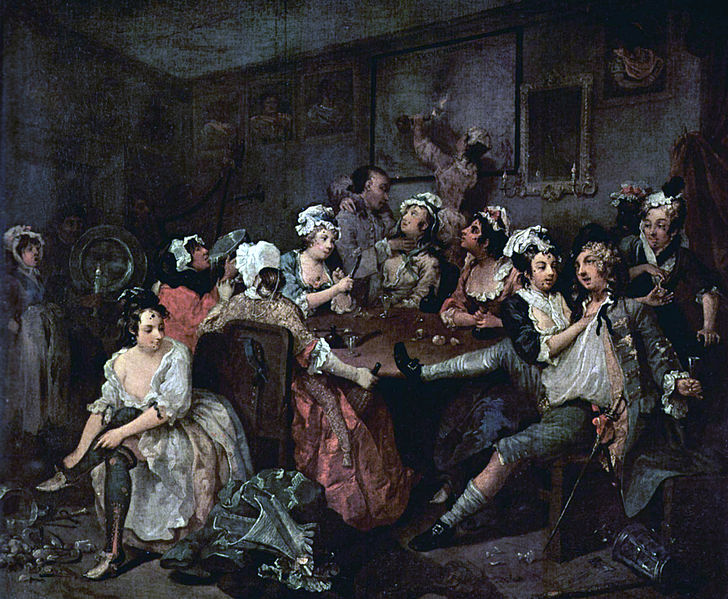
I feel it's only fair for me to begin with a discussion of one of William Hogarth's series of paintings, The Rake's Progress, seeing as this work was the inspiration for my blog title. For those of you that are unfamiliar with Hogarth, he was an 18th century English painter, who, among other things, was well-known for satiric depiction of the aristocracy. In The Rake's Progress, Hogarth tells the story of a man who inherits his father's fortune and uses it to fund a superfluous and ostentatious lifestyle, which, of course, included habits of a promiscuous nature. The rake's reckless ways eventually cause him to end up in Bedlam, a mental institution in London. The image I've provide below is the third painting in the series, "The Orgy." Eh-hem... I'm assuming there's no explanation needed here...
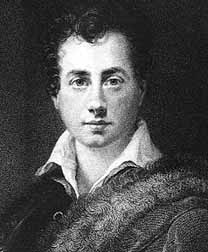
Moving right along... George Gordon Byron, a.k.a. Lord Byron, also seems to fit the OED's definition of a rake. Byron was an English Romantic poet, whose "reputation" extend beyond things of a literary nature (One of his most famous poems is "She Walks in Beauty, which you can read here: http://www.bartleby.com/101/600.html.). Because of his poetic prowess and handsome appearance, he was often an object of sexual desire for many women of his day--the 19th century Clive Owen, if you will. With a vast array of women at his beckon call, it's no wonder he led such a lewd lifestyle. (However, considering Byron's notoriously pleasure-seeking personality, it's likely that he would have found other ways to appease his sexual appetite had there been a lack of willing women.) Below is a picture of Lord Byron... quite the Don Juan if you ask me. (Ironically enough, the term "Don Juan," among other things, refers to a semi-autobiographical poem written by Byron, which tells the story of a sexually promiscuous male.)
The next rake on my list is also from the 19th century. However, unlike the above rakes, he is a fictional character from the 1939 film, Gone With The Wind, adapted from the novel by Margaret Mitchell. His name is Rhett Butler. For those of you that haven't seen this movie (By the way... you SHOULD! It's EXCELLENT! Definitely one of my favorites.), Rhett is exceptionally wealthy, but has "the most terrible reputation," to quote a gossiping woman from the film. Although throughout the course of the movie, Rhett is wooing (or at least attempting to woo) one woman, the heroine, Scarlett, he frequents the local house of ill-repute where his good "friend" Belle Watling is the "madam." Here's a funny video clip from YouTube that contains many of the scenes from the film in which Rhett exhibits sexually promiscuous behavior. The song "Tough Lover" is playing in the background: how appropriate.
At long last, we arrive at the present day: The contemporary rake is... drum roll please... Joey from the film 10 Things I Hate About You. Joey, like our other rakes, is wealthy, takes pride in his appearance, and, of course, harbors a wanton lust for a fleshy love; he's a horny high-school boy, who, to use a colloquialism, "gets around." Like some of the rakes from the readings, Joey takes pride in "conquering the virtuous." His object of desire, Bianca Stratford, is not only one of the most beautiful, popular girls in school, but a virgin. Here's the movie trailer, in which Joey makes a brief cameo with Bianca at the tail end of the clip.
The character of the rake doesn't seem to have changed much over the course of the 18th, 19th, and 20th/21st centuries. All harbor similar personality traits, and certainly fit the description of the seducers Early-American advice texts urged women to be on the watch for. Though they may appear mannerly and suave, their ultimate goal is to fornicate with females.
Greetings fellow coquettes *cough*witches*cough* (Yeah... still missing Salem...),
First of all, I'd like to send a shout out to all of the pure-hearted, good-intentioned men that spent time creating texts especially for me in hope of furthering my "feminine" education and influencing my development as woman (but of course, not as an individual, since I should not seek to cultivate a sense of personal identity, but blindly submit to blending in to a patriarchal imposed description of female norms). Your concern and interest concerning the education of women is truly touching, and I'm sure the best and brightest of my sex consider your advice to be invaluable: priceless...
PriceLESS, because a monetary value can't be determined, seeing as there is no going rate for absolute crap on the market.
Anyway...
When I read these "instructional" texts, primarily, I see the age-old tendency to encourage women to remain sexually pure, and embody the essence of all that is delicate and matronly. A woman must maintain her Virtue or face losing not only her reputation, but also her decreased value with respect to, or in some cases, complete removal from the marriage market. To paraphrase:
A woman should be the physical manifestation of all that is good, a marble idol of chastity and pristine morality that should never waver, falter, or tarnish. She is merely a decorative article that exists only for the purpose of pleasing her husband, one that sits on the kitchen mantle quietly and waits with wide eyes and unwavering devotion in hopes that he might bless her with a passing glance. Whenever he feels the desire, he will wrench her from her resting place, and with a fist constricted tightly around her torso, brush the dust off of her body with an air of bombastic ambivalence, and return her to the mantle with a fierce SLAM.
Well, this may be a slightly hyperbolic paraphrase (and I may have brought in a few things that weren't specifically mentioned in the advice passages), but the purpose behind the construction these instructional texts for women seems to be the same one behind the 1950s home-economics textbooks: an effort by men to maintain the prevailing patriarchal order via the encouragement of feminine weakness and submissiveness.
Also, as I read these texts, I started to wonder why men felt the need to publish them so extensively--why specifically during the late eighteenth century did they feel their authority was in jeopardy? Since a handful of these texts were published during the "Critical Period" of American History, I wonder if it was a response to Republican Motherhood of sorts, an attempt to reclaim some of the agency women had gained with the success of the American Revolution. Anway, it's just a thought.


 Although women often wore corsets to achieve a particular body shape and excessive buttons on clothing were part of the extravagant nature of Victorian style, they certainly aided in encouraging women to protect their virtue. Similar to Chinese foot-binding (though significantly more painful than corsets), restrictive clothing was a way of forcing women into physical submission by limiting their mobility, which re-enforced patriarchy as a result.