Thursday, September 25, 2008

"Fallen" Down

Greetings fellow Early-Americanists!

It's been a long night dancing in the woods with Satan, venturing out with lewd men, killing children, pillaging... well... you get the idea... Anyway, after all of my adventures (or rather misadventures), I feel like I'm equipped to answer the question at hand.


I've enjoyed reading these narratives; I've never picked up anything quite like them before. It's been interesting to watch them change and develop as the years in which they were published progress--a change that is reflective of the social and cultural developments between the late seventeenth century and the early nineteenth century. Overall, I have two primary observations to make about these texts:

1) As the narratives move from the Puritan "come-to-Jesus" tale to an adventure story of sorts, such as the "Panther Narrative," sexist comments and attitudes toward women seem to become more subtle. While one would like to think that this is evidence of American society moving away from patriarchy to a more egalitarian community, which would result in enlightened/better informed ideas about women and feminine nature, this is unfortunately not the case. As discussed in class, though women in Puritan New England were generally intellectual inferior to men with respect to their lack of a formal education, they still could read at a standard level and possessed the basic academic competencies needed to function in everyday life. However, as the years progressed, women gradually became more educated. There seems to be an inverse relationship forming between the amount of overt sexism present in the narratives and the extent of the scholarly and academic capabilities of women: as the latter increases, the former decreases. Obviously, if women are becoming more intelligent, therefore more able to recognize male diatribes against females, such commentary is going to need to be subdued. Though this may seem good, more subtle attacks against women are actually potentially more dangerous because they're harder to recognize--readers of narratives can be negatively influenced without realizing it!


2) On a more general note, the more recent narratives seem to be geared more toward entertaining the masses rather than moralizing/serving as a model of "good behavior." Although there are certainly morals, thoughts, and ideas that are promoted in newer stories (ex. "The Panther Narrative), they are nowhere near as blatantly emphasized as they are in earlier tales of religious revelation (ex. Esther Rodgers). Perhaps this is indicative of a gradual move toward secularism and a more consumer, entertainment-based culture.

Thursday, September 18, 2008

Women Woes

Good morrow to all of you wacky witches! ( I know we're done with Salem, but I'm still in mourning... at least allow me to cope with weak attempts at being humorous.)

It's kind of ironic... we've been reading these infanticide narratives with the understanding that multiple parts of a so-called "true account" were likely embellished, but I feel like certain parts of the narratives give a relatively accurate representation of some of the females at TCU. Now, as of this moment I haven't met a girl who's guilty of infanticide, but I have certainly overheard many a tale of extreme sexual promiscuity. I don't consider myself a prude, but based on what I've gathered, TCU seems to be an incubus of venereal diseases. (It's like the royal court of Henry VIII... well... sort of...)

Though I don't approve of women who sleep with everything and all things male, I don't feel like women should be judged for this sort of behavior... especially if men exhibit exactly the same behavior and no one gives it a second thought--the ol' double-standard. I think people can at least agree that for health reasons that being sexual loose isn't a good thing... but for crap's sake, it's not just women who spread STDs!

On another yet similar note, though women have the option of pregnancy termination and a variety of contraceptive devices at their disposal, I feel like they're often judged for their choice to utilize these resources. This isn't necessarily true in all cases, but regularly enough to note. For example, I think people tend to automatically assume that if a woman chooses to abort a baby it's because she made sexually careless choices, which may not actually be the case (What about rape, health reasons, financial issues, etc.???). Though woman have certainly come a long way in the last hundred years, it seems to me that age-old prejudices and stereotypes are still prevalent.

Thursday, September 11, 2008

Feministing

Salutations!

So... I've been trying to think of something really interesting and thought-provoking to say for this blog post... unfortunately, the muses have not been kind. I ask forgiveness for the mediocre quality of this response in advance.

I did enjoy reading the Rountree article. The concept of goddess vs. witch reminded me a lot of the Victorian (or at least the average Victorian male) conception of women: A woman was either a virtuous Victorian virgin or a "Fallen woman," (a phrase often used to refer to a prostitute) a social "castaway," if you will, to reference Augusta Webster's dramatic monologue told from the point of view of a "lady of the evening." (If you are interested in reading this poem, you can find it here: http://rpo.library.utoronto.ca/poem/2563.html) I realize I'm over-generalizing here, but for the most part if a woman failed to or did not aspire to become a domestic maternal Madonna of sorts, society gave her the stink eye (Note: Society=patriarchy. *cough*menaredumb*cough* Ha-ha. Just kidding... sort of...). Assumptions and judgements were often made about a woman based on her profession alone, that of course weren't necessarily true. For example, many single women became seamstresses in order to make ends meet. However, this job paid so little that it wasn't uncommon for seamstresses to take up prostitution in order to feed themselves. For this reason, being a seamstress was often equated with being a prostitute.


The role of the color pink in the feminist movement strikes me as a good example of "reclaiming agency." Pink is often rejected by feminists because of its sentimental, delicate, and "girly" connotations; to some it represents cliche female gender norms. However, lately the color pink has been embraced by feminists who see it as a color/symbol that can "speak" for women as a whole, not just "girly-girls." I don't know if this made any sense... I read an article on it once, which of course now I can't find... rats. I guess you'll just have to take my word for it. I swear on A Tale of Two Cities that I'm telling the truth! :)

Thursday, September 4, 2008

Tales from the Crypt

Good day witches of Salem. I have for ye a tale of horror and woe...

No, not really. But I do have a few stories concerning my accounts with the supernatural. Allow me to share one of them with you. (Ask me if you would like to hear more... I'd love to share!)

When I was in Salem, my cousin and I thought it would be fun to run around some of the old graveyards at night (By the way, I wouldn't recommend this unless you're with someone; there are SO many creepsters that hang out in cemeteries at night). It just so happens that the graveyard we decided to visit that night was the field where Giles Corey was pressed. While we were exploring, I felt like someone was behind me. I turned around expecting to see my cousin trying to scare me, but instead saw an orb. (F.Y.I. An orb is a white glowing sphere that is supposedly what appears before a spirit manifests itself.) I stared at it for about three seconds, and then it slowly faded away into the darkness. Much to my chagrin, I was not fortunate enough to see the ghost of Giles Corey, who is said to appear in that field now and then. (However, seeing his ghost is suppose to be a bad omen. The last time it was spotted was in the late 1990s by a ghost tour group. The next day a boy from the local high school killed himself.)


When I think of modern "witch hunt", the first thing that comes to mind is the McCarthy communist raids. Kudos to Arthur Miller for making that connection and putting his thoughts into the form of an utterly delightful play. Mmm... John Proctor...

I've actually had the misfortune of experiencing something similar to a witch hunt. When I was in high school, one of my teachers got wind that someone was selling typed sets of the lecture notes. Everyone was brought to her office and forced to show her their notes so she could review the them to see 1) if they were typed, and 2) if they matched the ones being sold. If the slightest phrase or sentence was even remotely similar to the contraband copy, she became suspicious. Lucky for me, I hand wrote my notes, but my friend typed hers. She was subsequently accused of cheating (erroneously I might add) and a portion of her semester grade was deducted as a result. I told my friend, who is of outstanding moral fiber, that she was the Rebecca Nurse of her time. She told me to shut and and quit being such a history nerd.

As far as a contemporary concept of evil is concerned, I think people often associate "evil" with what doesn't fit or match their concept of what something is... like any sort of modern day religious fanatic, for example. Like the Puritans, they see things in binaries; there's no room for error--no middle ground--only good and bad, right and wrong, saint (Elect) or witch.

Wednesday, August 27, 2008

Greetings from Goodwife (Goody) Cody

Hello, Everyone!

My name is Emily Cody, and I'm senior History/English double major. I was born in Dallas but currently reside within the sprawling metropolis (ha-ha) of Grapevine, Texas. I hope to someday become a history professor in Early Modern English History/Colonial American History.

If I were the Chancellor of TCU, among other things, I would make more of an effort to promote/encourage academic life on campus. Right now, it seems like sports and Greek organizations get a heck of a lot more press than, say, clubs such as the TCU Literary Society. After all, universities were designed for scholarly purposes. Right?

In my opinion, a good teacher is one that is passionate about his/her area of expertise and is able to inspire a similar fervor for inquiry in others. However, a good student is one who not only attends class regularly, meets deadlines, and the like, but who is committed to academic excellence for the sake of making themselves a more knowledgeable, intelligent, socially and culturally literate human being.

If I could dine with any three people, I would pick Helen Mirren (a.k.a. The Best Actress Ever), Elizabeth I of England, and my grandpa on my mom's side of the family (He died before I was born.).


Three things you should know about me:

1) I'm proud to be a complete and total nerd.
2) I'm a HUGE Anglophile but unfortunately have never been able to make the jump "across the pond." (However, I was fortunate to have the opportunity to visit Italy during the summer of 2002.) In short: I HEART the UK!!!
3) Three things that make life meaningful for me are: travel, knowledge (possession and the pursuit of), and compassion--not necessarily in that order.


Three things I would like to know about you:

1) What is your favorite word?
2) What are you most passionate about?
3) What are three things that make life meaningful for you?

Minus the fact that I need a pre-1800 and an American Literature credit to graduate with an English major, I took this course because I'm SUPER into the Salem Witch Trials. I took a trip to Salem with my family during the summer of 2004 and developed an unhealthy obsession with the events that took place in 1692. Since there isn't a topical studies class at TCU that covers colonial America, I have been unable to find an outlet for my macabre musings... until now. Dum, Dum, DUM!

As far as my reading preferences are concerned, I mainly read literary "classics," if you will, inside and outside of the classroom. However, I'm always open to suggestions. Basically, if it has some sort of literary merit and/or holds my interest (preferably a combination of the two) I'll read it.


Regarding writing, as I am a History and an English major, my writing is primarily of an academic nature. I don't do much writing outside of school, even when I have the time. I feel more comfortable with my ability to produce acceptable pieces of scholarly work rather than creative pieces (i.e. independent, out-of-class writing), which is probably why I've inadvertently restricted my writing to the classroom.

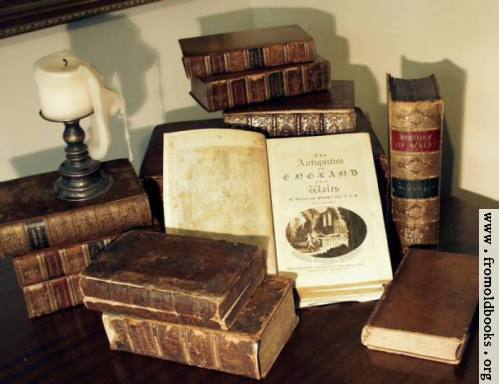
Right now, I think my blog is making a great argument for the fact that I'm an avid academic. For one, my profile picture is of me dressed up for the release of the seventh Harry Potter book. Not to mention I've chosen a style/layout for my blog that I thought most closely resembled 17th and 18th century documents--not to fit with the topic of the course... for me!!!


I have read, understand, and agree to the terms of the course syllabus.